
The Hot Chocolates
And ‘The Living Flame’

Hello beloved reader!
I’m interrupting the weekly serialization of A Balanced Earth to share a FUNENJOY story with you 🥰 (Yes, I made up this word. And yes, the capitalization is intentional.)
I’ve just arrived home from a four-day immersion at Modern Elder Academy, set on a breathtaking 2,560-acre ranch outside Santa Fe, New Mexico. I was there for an immersive workshop experience of Transformational Speaking with Gail Larsen, author of the book by the same name—and someone who truly earns her reputation as a midwife for the soul.
I first studied with Gail back in 2013 at the Omega Institute in New York. That’s where I encountered an idea that rearranged my interiority: many Indigenous cultures teach that we are each born with an original medicine and if we don’t express it in the world, it doesn’t simply lie dormant. It’s lost and gone forever.
Gail doesn’t tell you what your medicine is.
She creates the conditions where it reveals itself.
When your medicine changes
Here’s the twist: I learned this time that original medicine isn’t fixed.
In 2013, mine emerged clearly as The Spiritual Enthusiast, which made perfect sense. I was in the midst of a two-year program studying world religions, devouring wisdom traditions like sacred tapas.
This time? Different season. Different soul work.
Our first full day was devoted to group practices designed to reveal each person’s medicine as it exists now. As the day wound down, everyone else’s had landed. Mine hadn’t.
So I spoke into our circle of seven women, each of whom I was discovering carried a deep and living relationship with the Divine Feminine.
I wondered aloud whether my medicine might have something to do with the Heyoka—the Lakota sacred role often flattened into the term “empath,” but in truth a far more dangerous, vision-initiated calling. I recognized myself in some of the Heyoka qualities I’d read about: embracing paradox, mirroring truth, transformation through humor, connection to nature, deep self-inquiry, and the awareness that healing begins with oneself before it can be offered to others.
Heyokas are also often described as carrying multiple layers of perception at once—thoughts, emotions, and energetic information moving simultaneously. When something needs to be spoken, it can arrive with urgency, making it difficult to wait for the “right” conversational opening. I recognized myself in descriptions that note how Heyokas often interrupt—not out of disregard, but because what wants to be said presses forward all at once. (And people who know me will recognize that in me too.)
Then Gail introduced another possibility.
Koshare.
That night, full of nourishing food and divine curiosity, I did what any modern mystic would do: I Googled. I asked AI. I read. I listened.
Koshare—sometimes spelled Kóshare, Koshari, or Kósa—are sacred clowns found in several Pueblo cultures of the Southwest. They are funny, unmistakably so, but not in the casual or entertainment sense. Koshare are ritual figures whose humor carries spiritual intelligence that works sideways rather than straight on. Appearing during ceremonies, feast days, and dances, they often wear black-and-white body paint—symbols of duality and balance—and engage in exaggerated, absurd, or boundary-breaking behavior.
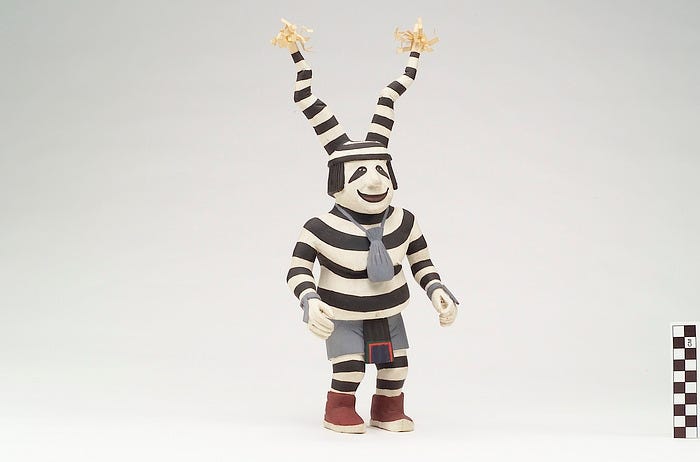
Beneath the laughter is their real work: saying what no one else is allowed to say.
At their core, Koshare practice sacred disruption. They mock social norms when those norms harden into ego, hypocrisy, or unconsciousness. They exaggerate human flaws—greed, vanity, control, sexual shame—so the community can see itself without collapsing into defensiveness. They deliberately break ritual perfection so ceremony does not devolve into spiritual performance.
Their disorder is not accidental. It’s sanctioned. Ritualized. In service of balance.
In Pueblo cosmology, harmony is fragile and must be actively maintained. Too much order becomes lifeless; too much seriousness curdles into arrogance. Koshare function as a kind of collective immune system, deflating spiritual pride, grounding the sacred back into the body, and protecting the community from taking itself—or its gods—too literally.
They belong to the global Trickster lineage (think Coyote or Hermes), but with a crucial distinction: Koshare destabilize from within the ritual, not from outside it. They don’t oppose the sacred. They keep it alive.
Psychologically, they enact a truth many cultures suppress: healing requires laughter, humility, and a willingness to look ridiculous.
(And by humility, I’m pointing towards not being identified with ego, in the Eckhart Tolle definition of ego.)
They model non-attachment to image, comfort with contradiction, and the courage to expose what is usually hidden, puncturing ego-spirituality before it hardens into control. In this sense, Koshare don’t ask whether something is correct; they ask whether it is alive—and if not, they laugh until it is.
Koshare are often confused with Heyoka, but they are distinctly different. Koshare are a collective, ceremonial role, entered with community sanction and worn temporarily within ritual space. Their task is to correct social imbalance through humor and visibility. Heyoka, by contrast, are a vision-initiated Lakota sacred role, often marked by illness, rupture, or lifelong dislocation. Koshare make you laugh at yourself. Heyoka make you feel what you are avoiding. Both disrupt ego and false order, and both protect the sacred from stagnation—but they arise from different cosmologies and carry very different medicines.
This is what I learned that evening in my room. Still, nothing had quite landed. So I surrendered to the mystery and went to bed. Then, just as I was falling asleep, this dropped into my mind:
The Living Flame🔥🙏
An original medicine that burns away what is false.
That offers warmth and healing, like sitting before a fire.
That carries the energy I will need to finish writing A Balanced Earth.
~~~
In our circle the next day, we laughed and we cried. We spoke of the depth of trauma and suffering in the world right now. One woman from Minneapolis named what many are feeling: the violence in her city is no longer just political—it’s a matter of human rights.
We spoke of the staggering prevalence of sexual abuse, especially of women and children. I wanted to share a story about a friend—a lawyer who represented sexually abused children—who taught people that it is never the victim’s fault. When she took her work to Italy, she found she needed a metaphor grounded in food to help the Italians understand.
“There’s a chocolate on the table that looks unbelievably delicious,” she would say. “So scrumptious you can’t help but eat it. But you need to understand—it was not the chocolate’s fault that you ate it.”
That’s the story I *meant* to tell.
But the Living Flame had other plans.
Instead, I heard myself say:
“I may be a chocolate—but that doesn’t mean you get to eat me.”
We all erupted in laughter. After that, we named ourselves:
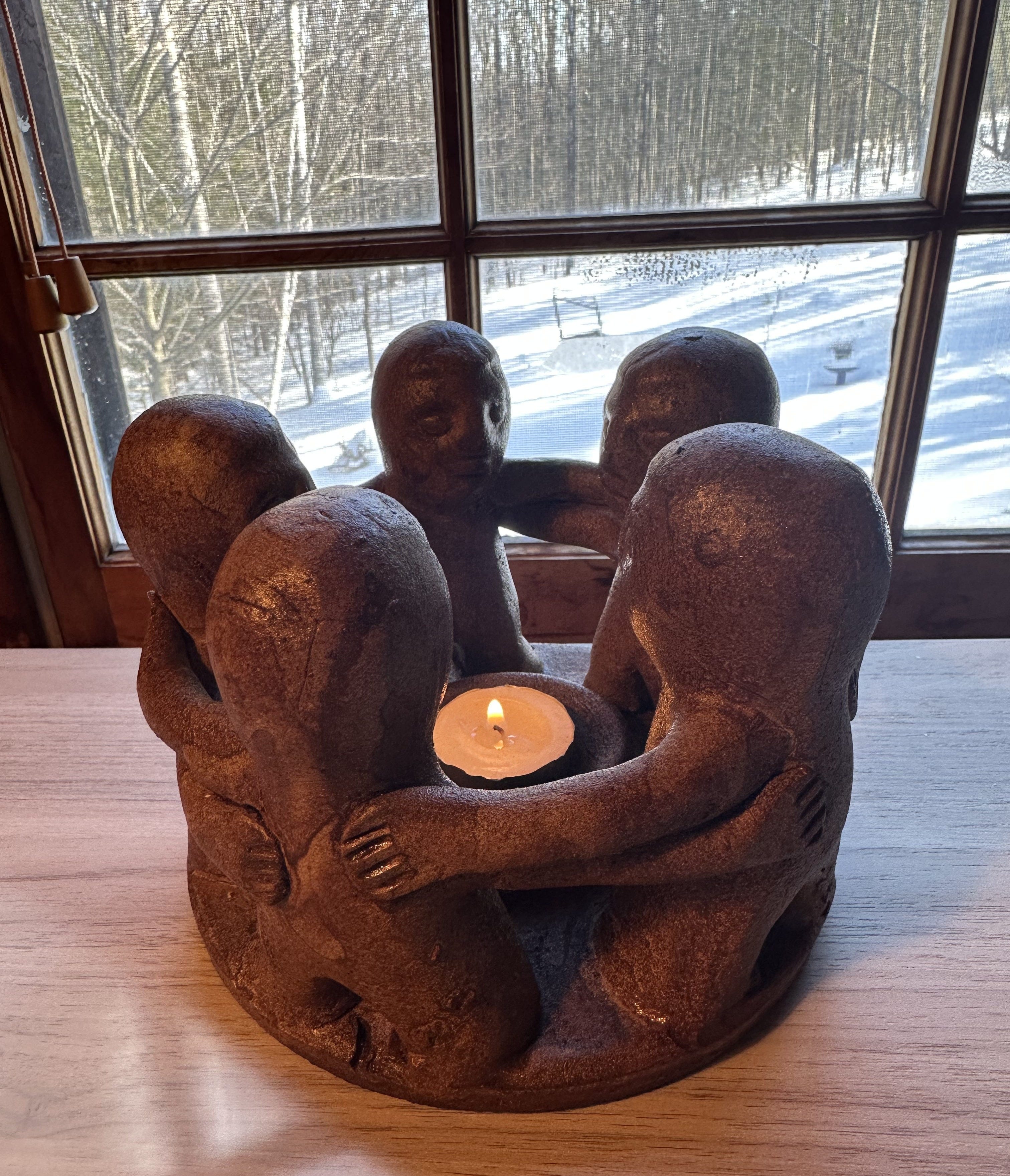
The Hot Chocolates.
Sometimes the medicine arrives laughing.
And sometimes… it’s on fire.
Lovely to hear some of your experiences Camilla and insights from this momentous workshop. I know about the trickster energies that are also needed now in all its forms and names.
I’m so glad you shared this. It feels like you were immersed in wisdom, curiosity, and community. What a rich journey. Grateful for your gifts regardless of how they are named. 💕